


The Institute of Transportation of the Ministry of Transportation and Communications (IOT, MOTC) has successfully completed an AI-driven technology validation for cross-domain public transportation information integration services, marking a new milestone in smart mobility development. By leveraging cloud-based Large Language Models (LLMs), the Institute of Transportation validated Transportation AI Agent technolog in 2025, demonstrating AI-powered public transportation information inquire and an automatedtaxi-booking service branded as AI Go.
With AI Go, users can simply interact through natural language to obtain integrated public transportation information across regions and make taxi reservations, without the need to download or learn multiple transportation APP. This innovative approach significantly lowers digital barriers and provides an important technological foundation for future one-stop transportation information services.
Currently, transportation information is scattered across different platforms and websites, often requiring users to switch between multiple interfaces to search for travel information or make reservations. That process can be inconvenient and challenging, particularly for elderly users, intercity travelers, and tourists. To address these issues, the Institute of Transportation introduced cloud-based LLM technologies and developed the AI Go service framework as part of this technology validation initiative.
For AI-powered public transportation information inquire, AI Go adopts Google Gemini technology. Users can input trip origins and destinations using natural language, and the system automatically understands user intent and integrates APIs to deliver both static and real-time bus information. For automated taxi booking services, Microsoft Azure OpenAI technology is applied. Through simple language requests, the system can automatically identify essential information, such as pickup location, destination, and contact details, and complete taxi reservations seamlessly. This effectively enhances the last-mile connectivity within the public transportation system.
Looking ahead, the Institute of Transportation has also planned a range of application scenarios to expand the AI Go services. In rural and remote areas, AI Go can be integrated with services such as the Happiness Bus to simplify information inquiries and booking processes, helping rural elderly users bridge the digital divide. In metropolitan areas, the Institute of Transportation will support interested special municipalities, including Taichung City and Kaohsiung City, in deploying AI Go services to further expand integrated public transportation information and taxi booking service. At airports, collaborations with facilities such as Taichung International Airport and Kaohsiung International Airport are planned to provide arriving passengers with immediate access to AI Go services, guiding them to ground transportation options and taxi booking services to improve transfer efficiency and travel experience.
By enhancing the overall user experience of cross-domain public transportation information services, AI Go is expected to increase the effectiveness of TPASS periodic passes across metropolitan areas and align with the policy goals of the Ministry of Transportation and Communications’ AI Promotion Committee. Serving as a demonstration case for Taiwan’s public transportation AI transformation, the Institute of Transportation will continue advancing AI-driven transportation information services in collaboration with central and local transportation authorities, gradually building a nationwide one-stop Transportation AI Agent service.
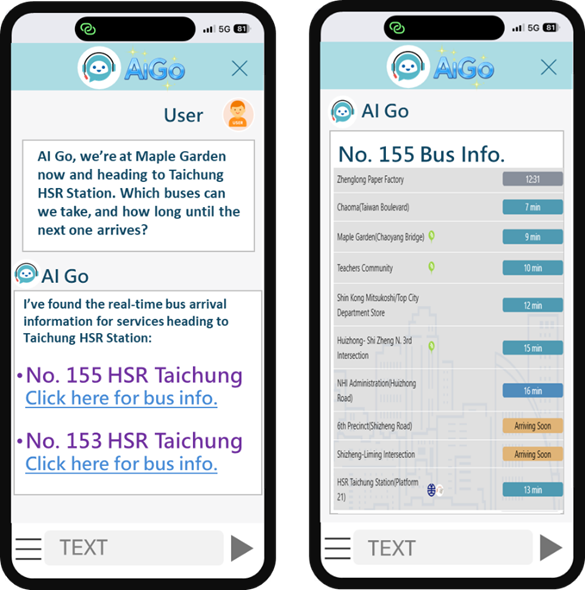 Fig. 1 AI Go: Automated Public Transportation Information Inquiry
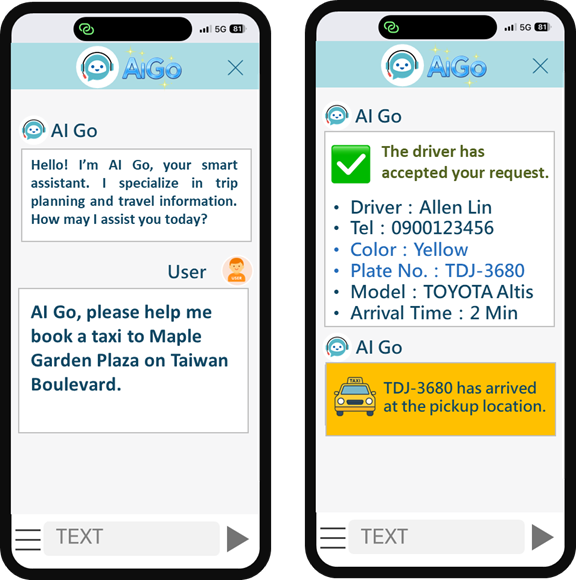
Fig. 2 AI Go: Automated Taxi Booking
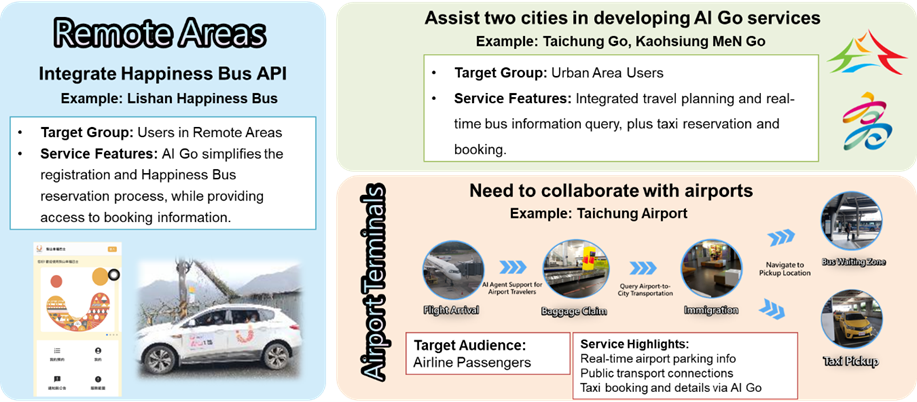 Fig. 3 AI Go: Future Deployment Scenarios